
Afterpay Tattoo Toronto

What should you confirm before booking an Afterpay tattoo in Toronto?
Confirm the tattoo first, not the payment method. You should be clear on the concept, style, placement, approximate size, and which artist is the best fit. If those basics are still vague, a consultation matters more than financing. Payment flexibility can help you manage a larger project, but it should not be the reason you move ahead with a design that is still unresolved.
What needs to be clear before you book?

At minimum, you should know what you want, where it should go, how large it likely needs to be, and what style you are actually asking for. That does not mean every tiny detail must be finalized before you reach out. It does mean the core idea should be stable enough for an artist to judge whether it will work well on skin.
Try to answer these questions in plain language:
- What is the subject or concept?
- What style is it really: fine line, blackwork, realism, Japanese, illustrative, lettering, or something else?
- Is it meant to read softly up close or clearly from a distance?
- Is it likely a one-session tattoo or a larger project?
- Are there any elements that absolutely must stay?
If you cannot answer most of those yet, the issue is probably not payment. The issue is that the tattoo still needs development.
How do size and placement affect whether the tattoo is a good idea?
Size and placement should be decided by readability and long-term clarity, not just by budget or convenience. A design can look great on a phone screen and still be a poor fit for the size or body area you want.
For example, a very detailed portrait on a small wrist asks the skin to hold more information than it realistically can over time. A delicate floral may work beautifully at a smaller scale, but only if the design is built for that scale rather than simply shrunk down.
Good placement and sizing decisions usually come back to a few practical criteria:
- How much detail needs to stay readable after healing
- How much the area moves, stretches, or rubs
- Whether the style needs bold contrast or open space
- How the design flows with the body
- How visible you want it to be in daily life
If an artist recommends going slightly larger, simplifying the design, or moving it to a better area, that is often a sign they are protecting the final result.
What should the consultation resolve?

A good consultation should reduce uncertainty. By the end, you should have a clearer sense of the design direction, scale, placement, technical fit, and what may need to change.
Useful consultations usually resolve these points:
Is the concept strong enough for tattooing?
Some references are attractive images but weak tattoo designs. The artist should be able to tell you whether the idea translates well to skin.
Is the artist the right fit?
A strong portfolio match matters. Fine line, blackwork, realism, Japanese, and illustrative work all solve design problems differently.
Is the scope realistic?
You should know whether the tattoo is likely to be a smaller single-session piece or a larger multi-session project.
What needs adjustment?
Common adjustments include size, contrast, level of detail, composition, or placement.
What will it likely look like healed?

Fresh tattoos and healed tattoos are not the same. Expectations should be based on how the work will settle over time.
If the only thing that feels clear after the conversation is the payment option, pause before booking.
Professional Perspective
An experienced tattoo artist does not judge the artistic side of a financed booking differently. The same standards still apply: artist fit, scale, placement, readability, healing, and long-term clarity.
What changes is the decision risk for the client. Payment flexibility can make it easier to commit before the design is fully resolved. That is why the tattoo itself has to be evaluated carefully.
Here is what matters most:
Is the tattoo decision settled without the payment plan?
If the instalment option is the main reason the booking feels possible, slow down. A permanent tattoo should still make sense if you strip away the convenience of the payment structure.
Does the requested scale support the style?
Fine line, blackwork, realism, and Japanese work all need different amounts of space. The skin can only hold so much information cleanly.
Does the placement support longevity?
Some areas are better for crisp detail, balanced composition, and predictable healing. Others create more distortion, friction, or visual compression.
Does the artist’s healed work match the problem your tattoo presents?
Look beyond fresh photos. Healed-looking line quality, shading control, contrast, and composition matter more than general popularity.
Are expectations aligned before the appointment?
You should understand what can be done well, what should be simplified, and what trade-offs come with your chosen size and placement.
The best tattoo bookings usually feel considered, not rushed.
What are common mistakes to avoid?

A payment option can be useful, but it can also make people move too quickly. The most common mistakes are not financial mistakes. They are tattoo-planning mistakes.
Choosing by availability instead of fit
The first open appointment is not automatically the right one. Style match matters more than speed.
Making the tattoo too small to reduce cost
Smaller is not always cheaper in a useful way. If shrinking the design removes readability, contrast, or negative space, the tattoo may lose what made it appealing.
Approving a design you do not fully understand
If you are unsure how it will sit on the body, wrap around a limb, or read from normal viewing distance, ask before the appointment.
Treating financing as a reason to skip hard decisions
Payment flexibility can help with access. It cannot fix weak composition, poor placement, or a style mismatch.
When should the recommendation change?
Sometimes the right answer is not “book now.” A good recommendation may change if:
- the design is too detailed for the intended size
- the body area is a poor match for the style
- the artist’s portfolio does not solve the same kind of problem
- existing tattoos affect spacing or flow
- scar tissue or skin texture changes what is realistic
- the concept is meaningful but visually underdeveloped
- the project should be split into stages instead of forced into one session
That is not a failure. It is often how better tattoos get planned.
Which HON Tattoo Studio artists may fit different styles?
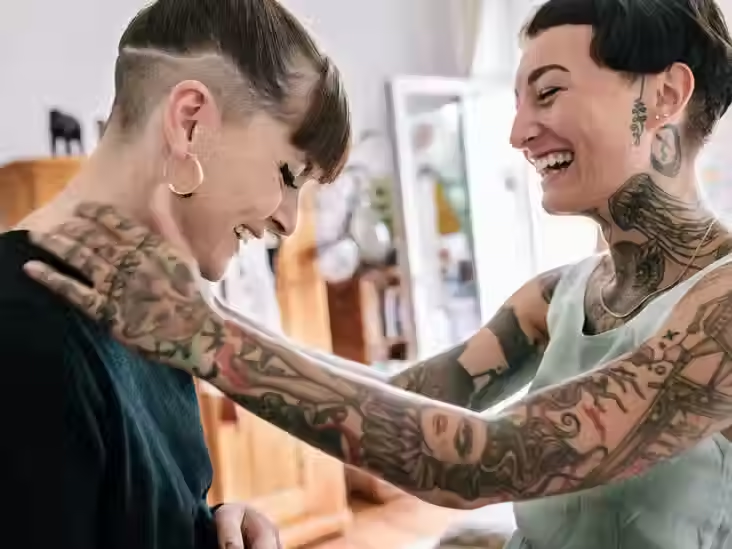
The most useful next step is usually narrowing by style rather than by payment method alone.
Fine line
- Winnie — Vaughan
- Brandon — Vaughan
- Anu — North York
- Jennifer — North York
- Anji — Downtown
- Rima — Vaughan
Micro realism
- Rima — Vaughan
- Oliver — North York
- Marcus — Downtown
Black and grey realism
- Anthony — Vaughan
- Jeesoo — Vaughan
- Piven — North York
- Bahador Erfani — North York
- Cris — Downtown
- Vincent (VK) — Vaughan
Blackwork
- Nika — Vaughan
- Alex — North York
- Yongha — Downtown
- Sarah — Downtown
- Min — Downtown
Japanese
- CT — Vaughan
- Sho — Downtown
Illustrative and colour illustrative
- Madelyn — Vaughan
- Ryanne — North York
- Claudinne — North York
If your idea crosses styles, it usually makes sense to ask for guidance instead of forcing a quick self-match.
Frequently Asked Questions Afterpay Tattoo Toronto
Can I book first and finalize the design later?
You can begin the process before every visual detail is locked in, but the core concept, style, placement, and approximate size should already be clear. If those basics are still unsettled, a consultation should come before a firm commitment.
Is a larger tattoo always a better use of Afterpay?
No. A larger tattoo is only the better choice if the design actually needs more space for readability, contrast, and long-term clarity. Some ideas become stronger when simplified rather than enlarged.
How do I know if an artist is the right fit for my idea?
Look for a portfolio that solves the same problem your tattoo presents: similar style, similar level of detail, similar subject matter, and strong composition on the body. Healed quality and consistency matter more than broad versatility.
Should I change placement if the artist recommends it?
Often yes, if the reason is readability, flow, healing, or long-term clarity. A small placement change can make a major difference in how the tattoo sits and ages. Ask for the reasoning so you understand the trade-off.
Related artists
- Winnie
- Rima
- Anthony
- Nika
- Sho
- Marcus
Related styles
- Fine line tattoos
- Micro realism tattoos
- Black and grey realism tattoos
- Blackwork tattoos
- Japanese tattoos
- Illustrative tattoos
Related areas
- Downtown Toronto
- North York
- Vaughan
Related articles
- How to choose the right tattoo artist for your style
- What to bring to a tattoo consultation
- How tattoo size affects detail and longevity
- Fine line vs blackwork: which ages better for your idea?
- Questions to ask before booking a realism tattoo
If you are comparing options, narrow the style, placement, and size first. Once those are clear, it becomes much easier to decide whether the booking actually makes sense.
Visit Hon Tattoo Studio
Downtown Toronto
202 Queen St W, 2nd Floor, Toronto, ON M5V 1Z2
(437) 533 7749 - hontattoodowntown@gmail.com
North York
6293 Yonge St, North York, ON M2M 3X6
(905) 604 5102 - hontattoostudio@gmail.com
Vaughan
9671 Jane St Unit 4, Vaughan, ON L6A 3X5
(416) 728 8922 - hontattoovaughan@gmail.com
Website: hontattoo.com
Instagram: @hontattoostudio
Also, if you click the button below and send us your tattoo-related questions, we will do our best to provide you with accurate answers.


